



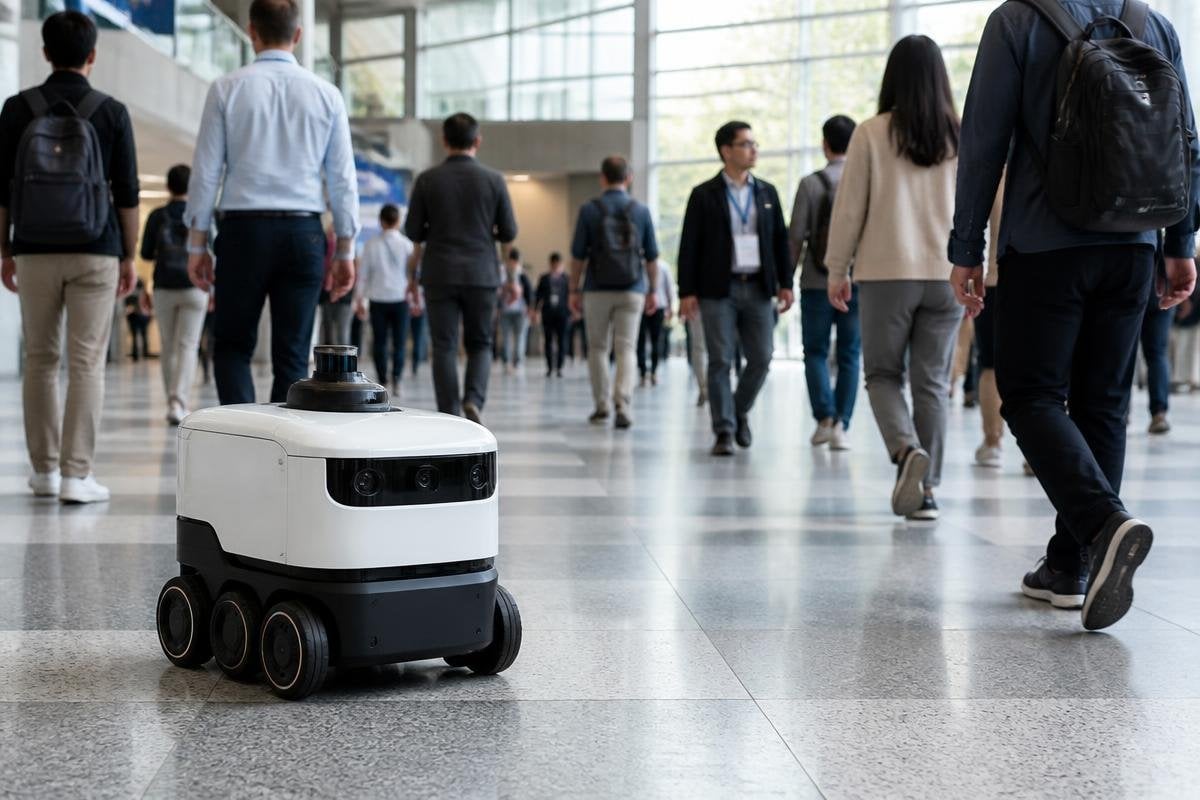
A robot moving through a busy hall must track people, estimate where they will go, and choose a safe path at the same time. It learns this task through sensor data, motion rules, and repeated checks against what happens around it.
- Cameras and LiDAR show nearby people, walls, and objects.
- Prediction software estimates how the scene may change.
- A local planner picks a path that can change within seconds.
What the robot sees
The robot starts with sensors. Cameras record color and shape. LiDAR sends out laser pulses and measures their return time, which gives the robot distances to nearby objects. Some systems also use depth cameras, wheel sensors, or an inertial measurement unit that tracks motion and tilt.
The software combines these readings into a local map. “Local” matters here. A full building map can show doors and corridors, but it can’t tell the robot that a person has stopped in front of it. The local map is refreshed as the robot moves.
Sensor data is noisy. A person may be partly hidden behind a cart, and a glass wall may confuse a laser sensor. The robot compares several readings over time instead of trusting one frame. This helps it separate a moving person from a fixed object.
How it predicts movement
Seeing a person is only the start. The robot also needs an estimate of that person’s next position. It can track direction and speed, then test several possible paths for the person and itself.
This does not mean the robot knows what someone intends to do. It works with a short forecast. A person walking toward a doorway may turn, stop, or change direction, so the robot keeps updating the estimate as new sensor readings arrive.
The robot also follows movement rules. It may keep a set distance from people, slow near blind corners, or stop when its sensors cannot confirm a clear route. Those rules turn uncertain sensor data into a safer driving choice.
How a path gets chosen
A path planner scores possible routes. It checks distance, travel time, turning room, and the chance of hitting an object. The chosen route is sent to the drive system as a series of small motion commands.
That process repeats many times during a trip. The robot does not pick one line and follow it without checking. It plans a short section, moves, reads the space again, and changes course when the scene changes.
A useful system also separates route planning from collision avoidance. Route planning may send the robot around a room. Collision avoidance handles the person who steps into its path two seconds later. Keeping those jobs separate makes faults easier to find and rules easier to change.
A robot can avoid a person once. Learning matters when it can use that event to choose a safer path next time. Robot24 reports on the machines and systems behind these claims, giving you a way to check what was learned before the next section separates learned behavior from hand-written rules.
Where learning fits
Engineers can train software with recorded sensor data and simulated traffic. The system sees many examples of people crossing, stopping, turning, or walking close to the robot. It then adjusts its model so its predictions better match those examples.
Training alone doesn’t settle the safety question. A robot can perform well in a simulation and still meet a lighting change, a reflective floor, or a person carrying a large box that the training data did not cover.
Engineers test the learned model inside limits set by safety rules. The robot also needs a way to fail safely. If its sensors disagree, it can slow down or stop.
If a person moves too close, the drive system can cut speed before the planner finds a new route. These responses matter more than a smooth path through an empty test area.
I’d trust a robot in a crowded space only when its stop behavior is clear, repeatable, and tested outside a clean demo route.
A practical check before deployment
Use this checklist when you review a robot for a public building, warehouse, or hospital:
- Sensor coverage: Check what the robot can see near its base, sides, and rear.
- People tracking: Ask how the system handles a person who stops or changes direction.
- Replanning speed: Find out how often the robot reads the scene and picks a new path.
- Failure response: Test what happens when a sensor is blocked or readings disagree.
- Human controls: Confirm where staff can stop the robot and how quickly it stops.
- Test setting: Compare clean demonstrations with the lighting, noise, and traffic of the real site.
Moving through crowds requires perception, prediction, planning, and safe stopping. The next useful proof is not a longer demo. It is a record of how often the robot slows, stops, or asks for help in the actual space where people will meet it.